
Recent Changes in High-End Fragrance Production for Gifting
The part of luxury fragrance production that has changed most in recent years is not the perfumery. It is everything around the liquid: how packaging is specified, how materials are reviewed, how batches are documented, and how much of a premium range can be produced on a compressed calendar. Those shifts create trade-offs that a festive gifting range feels immediately, because gifting compresses every decision into a window where a packaging question and a materials question arrive in the same week. Understanding which trade-offs are real and which are habits is what separates a premium range that ships from one that is redesigned in October.
Key takeaways
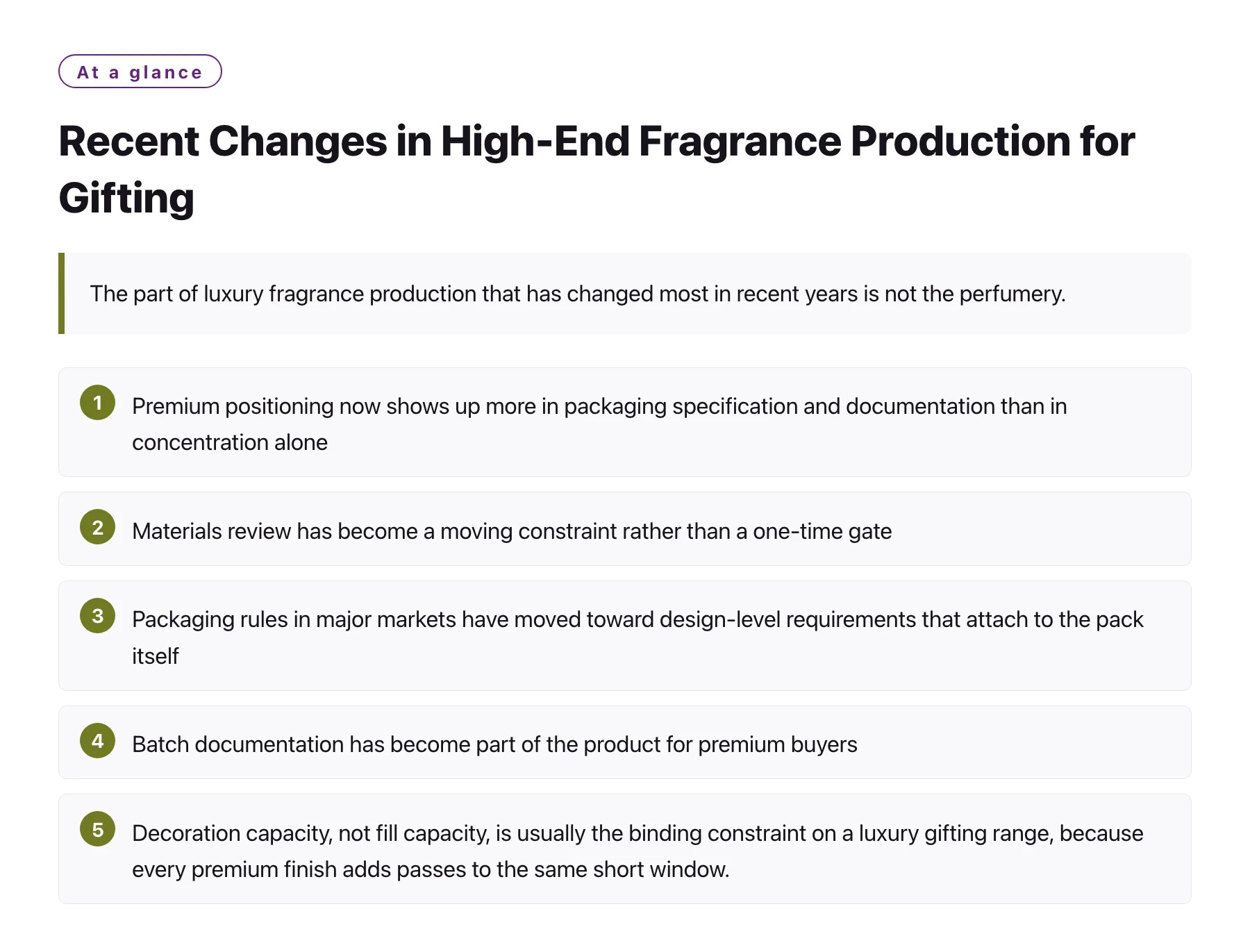
- Premium positioning now shows up more in packaging specification and documentation than in concentration alone, which changes where a range should spend its budget.
- Materials review has become a moving constraint rather than a one-time gate, so a formula approved for a market can require attention again later in its life [2].
- Packaging rules in major markets have moved toward design-level requirements that attach to the pack itself, which limits some premium finishes that were previously uncomplicated [1].
- Batch documentation has become part of the product for premium buyers, and the reference standard is the document that most often decides whether a reorder matches the original.
- Decoration capacity, not fill capacity, is usually the binding constraint on a luxury gifting range, because every premium finish adds passes to the same short window.
- The durable trade-off is between distinctiveness and repeatability: a finish that is hard to reproduce will also be hard to reorder identically.
Ask a production lead what has changed in premium fragrance work over the last several years and the answer rarely mentions new ingredients. It mentions documentation, packaging approvals, and the amount of the calendar consumed by decoration. The scent is still the point of the product, but the operational difficulty has migrated to the parts of the range that have to be identical every time.
That migration matters most in gifting. A festive range is judged against a high visual standard and produced against a fixed date, so it concentrates the premium trade-offs into a few weeks. A finish that needs three passes is beautiful and slow. A pack that uses a mixed-material construction is elegant and increasingly constrained. A scent formula that performs well may still need attention if a material's review status moves.
These are not reasons to avoid premium work. They are the trade-offs worth naming at the design stage, when changing them costs a conversation rather than a tooling run.
What changed, and what it costs in a premium gifting range
| Dimension | Some years ago | Now | Practical effect on a festive range |
|---|---|---|---|
| Packaging specification | Weight, finish and presentation were the main criteria | Material choice, separability and recyclability are part of the specification | Some mixed-material gift constructions need rethinking before the design is locked |
| Materials review | Treated as an entry gate for a new formula | An ongoing constraint that follows the formula through its life | A formula can need attention for reasons unrelated to the brand or the market |
| Batch documentation | Delivered on request for larger accounts | Expected as part of the product for premium buyers | Reference standards and records have to be planned into the project, not added later |
| Decoration | One dominant finish per component | Multiple passes, combinations and special effects are common | Added passes compete for the same capacity in the same pre-holiday window |
| Approval cycles | Physical samples sent by courier | Digital previews followed by physical approval | Previews speed up review but do not replace the physical approval step |
| Reordering | Reference retained by the manufacturer for its own use | Reference expected to be available to the brand as well | The reorder conversation starts with documents rather than with a new sample round |
None of these shifts is dramatic on its own. Together they explain why premium gifting projects now spend more time on specification and approval than on creation. A range that plans for that pattern absorbs the changes; one that assumes the old sequence discovers them late.
The trade-offs worth naming at the design stage
The first trade-off is distinctiveness against repeatability. A premium finish that is difficult to reproduce will be difficult to reorder as well, and a reorder that arrives slightly different undermines the very thing the finish was chosen to signal. Before approving an unusual decoration, it is worth asking what the production tolerance is and how the approved sample will be retained so that the next run can be compared against it.
The second is material quality against regulatory durability. Packaging requirements in several markets now attach to the packaging design itself, which means a construction that passed without comment a few years ago may need rework for a new market entry [1]. The sensible response is to ask for the material list and the separability of components during design, when an alternative insert or box is still a drawing.
The third is materials stability against a fixed formula. Review of fragrance materials is a continuous process rather than a single approval, and a formula's status can change over its commercial life [2]. Premium ranges with long production cycles are exposed to this more than short-run products, which is an argument for checking the headroom in a formula before it becomes the signature of a whole gifting line.
Where the luxury budget actually goes now
For a premium gifting range, the visible budget tends to sit in decoration and presentation, and the invisible budget sits in documentation, testing and approvals. Both are necessary, and they compete for the same weeks. A useful exercise at the design stage is to list which elements are meant to be seen by the customer and which exist to make the range repeatable, then confirm that the schedule protects the second group as carefully as the first.
It also helps to know which side of the work a partner treats as its own responsibility. Manufacturers that build fine fragrance, home fragrance and scented body products in the same operation, such as Xuelei, tend to have a settled view of where specification ends and production begins, because they live with the consequences of that boundary on every reorder. That is the kind of operational view a premium range depends on, and it is worth testing in a first conversation rather than assuming it.
What this means for the Christmas calendar
A gifting window removes the usual recovery mechanism. In a core line, a delay is an inconvenience; in a festive gifting range, it is a lost season. That is why the changed premium trade-offs matter disproportionately here: every additional approval, every extra decoration pass and every material question consumes days that were never generous to begin with.
One habit that helps is to separate fixed-date items from fixed-quality items and schedule them differently. Artwork and decoration approvals sit on the fixed-date path. Testing and documentation can often run alongside production rather than before it, provided the sequence is agreed in advance. Manufacturers that handle quality control in luxury fragrance production as a set of gates rather than as a final inspection will usually have a view on which gates genuinely have to precede production.
If a premium gifting range has to be simplified somewhere, simplify the finish rather than the documentation. A decoration that takes one pass instead of three is a visual compromise that customers rarely notice. A missing reference standard or testing record is a commercial risk that surfaces at the worst possible moment, usually when the range is being reordered at speed. For brands that want a single partner covering fine fragrance, home fragrance and body products, the practical test is whether development and production sit with the same team, which is what custom fragrance R&D and production means in operational terms rather than in marketing ones.
Sources
- European Commission: Packaging Waste and the PPWR —— EU rules on packaging and packaging waste, including the Packaging and Packaging Waste Regulation requirements on recyclability and design.
- IFRA: Safe Use and Fragrance Science —— IFRA's explanation of how fragrance materials are scientifically assessed for safe use and how those conclusions are applied by the industry.
Frequently asked questions
Has premium fragrance production become harder in recent years?
It has become more documented rather than more difficult. Formulation practice is broadly stable, while packaging specification, materials review and batch records have taken on more weight. The effect is that a premium range now needs more planning around approvals than around the mixing itself.
Does luxury positioning require a higher fragrance concentration?
Not automatically. Concentration affects how a scent performs and how long it lasts, but premium positioning is carried by the whole product: materials, construction, pack quality and consistency between batches. Many premium ranges are built at concentrations that are unremarkable on paper.
Why is decoration the bottleneck for gifting ranges?
Because every premium finish adds passes to a process with a fixed throughput, and all gifting production competes for the same capacity in the same weeks before the season. Fill capacity is often available when decoration capacity is not, which is why decoration is the line to protect first.
What should a brand keep from a premium production run?
The retained reference from the approved batch, the specification version that was produced, the testing reports, and the packaging artwork with its dielines. Together they make it possible to compare a reorder against the original rather than relying on memory.
Can a premium gifting range be produced with a shorter development cycle?
Yes, if the scope is narrowed rather than the schedule compressed. Selecting a scent from a library, using an existing bottle mould and limiting decoration passes reduces the work to be done. Compressing the same scope produces the same tasks in less time, which shifts cost into overtime and express freight rather than removing it.
Have a project on the horizon?
Tell us what you're cooking. Fixed-price quote in 4 hours, first frames in 9 days. Senior animators, no juniors in the chain.