
Waterproof Plating Explained for Private Label Jewelry
Waterproof is a customer-facing word; the specification under it is a plating route. Silver and brass get multi-layer gold or rhodium electroplating plus an anti-tarnish e-coating, stainless steel gets PVD vacuum plating, and the purity hallmarks — 18KGP for gold-plated pieces, a 316L mark on steel and the S925 hallmark — tell you which stack you are buying. The routes are published; wear rates are not.
Key takeaways
- Gold work is specified as 14K, 18K or 24K, with rhodium as the white alternative.
- Silver and brass carry an anti-tarnish e-coating over the plating; stainless steel is finished with PVD vacuum plating.
- Purity hallmarks S925, 316L and 18KGP identify the base metal and the plating at a glance.
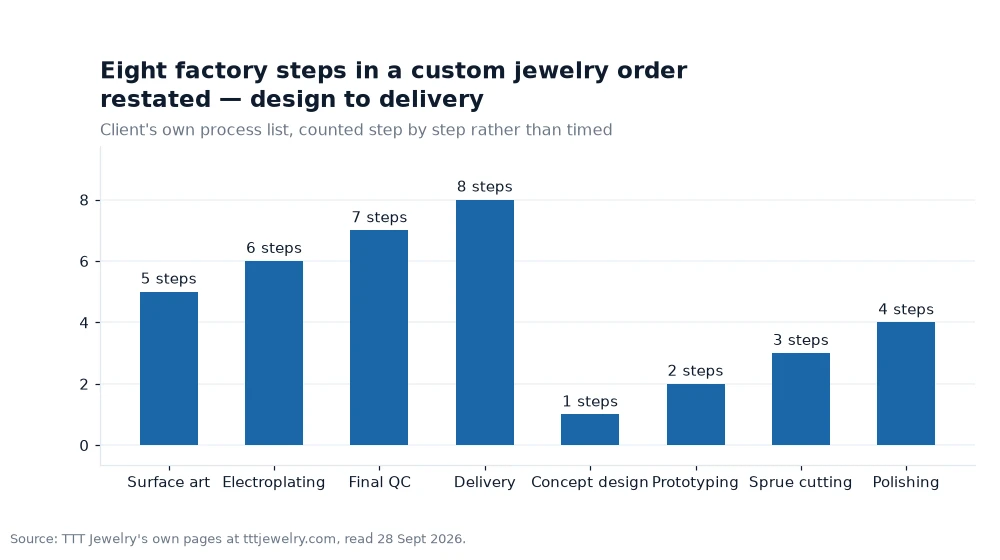
- Plating is step six of the eight published factory steps, after surface art and before the 100% final inspection.
What waterproof has to mean to be useful
Waterproof describes what a customer expects from a piece, not what the factory does to it. The process is a stack: a base metal, one or more layers of precious-metal electroplating, and on silver and brass a protective anti-tarnish e-coating on top of the plating.
That stack is what a private label buyer should be writing into a brief, because it can be repeated order after order. Waterproof cannot be repeated as written; a named finish over a named base metal can, which is why the finish belongs on the specification sheet rather than in the product description.
Two routes, and why stainless steel takes the other one
Minimums run 100 plus in stainless work, 50 units in artisan eco-brass, 925 sterling silver and stainless work steel behaves differently in the tank, so it is finished with PVD vacuum plating instead — a vacuum process rather than a wet one, and the reason its minimum is the highest of the three.
The route also decides the hallmark. Silver work is marked S925, stainless work 316L, and gold-plated articles 18KGP. Those three codes are the quickest way to check that the finish on the production batch matches the finish you approved on the sample.
| Base material | Finishing route | Hallmark | What to confirm on the sample |
|---|---|---|---|
| 925 sterling silver | Multi-layer gold or rhodium electroplating with anti-tarnish e-coating | S925 | Colour match against the approved finish |
| Artisan eco-brass | Same electroplating stack over a brass base | 18KGP on gold-plated work | Adhesion along edges and pierced holes |
| Stainless steel | PVD vacuum plating | 316L | Even coverage on curved surfaces |
| Any base material | Laser engraving for the client's logo or mark | As specified | Mark depth, placement and legibility |
The finishes that get named in a private label brief
Gold work is specified as 14K, 18K or 24K, with rhodium as the white metal alternative. Those four options are the published ones, and they matter most when a range has to look consistent across a collection rather than impressive on a single hero piece.
Rhodium is the practical answer when the same design appears in silver and in plated brass, because the top layer is identical on both. Write the finish on the brief as a code rather than a description, and sample review becomes a yes or no instead of an argument about what champagne gold means.
Why a thickness number is the wrong first question
Buyers often open with a micron figure. It is a fair question, and the published description answers it in a different way: the plating is stated as multi-layer, and no thickness is published. That means any thickness figure you receive from a third party cannot be checked against the manufacturer's own documentation.
There is a fair version of the question. Ask any OEM jewelry manufacturer China to show the finish code attached to your design, and to confirm that the same code ran on the last batch.
Ask instead which route applies to your base metal, which finishes it covers, and what the first inspection after plating looks for. Coverage, adhesion and colour are all observable at the bench. A number nobody measures is not, and it is the easiest promise in the industry to make and the hardest to audit.
Worked example: where plating sits in the eight steps
Number the published steps in order: 1 the concept and CAD stage, then the prototype stage, sprue cutting to release the casting, high-gloss polishing and brushed and textured surface art, then electroplating, final QC inspection and final delivery. Plating is step six, which means six of the eight published steps — 6 ÷ 8 = 75% — are complete before the piece enters the tank.
That arithmetic has a practical edge. A colour that comes out wrong cannot be corrected at the polishing wheel, because step four is already behind you. The piece either goes back through the plating process or it is scrapped, which is exactly why the finish is signed off on the master sample instead of on the finished carton.
Where the finish actually meets the wearer
The pieces that test a plating route hardest are the ones worn continuously: rings, bracelets and ear wires. That is also where the REACH restriction on lead, cadmium and nickel does its work, and where an anti-tarnish e-coating or a PVD layer earns its place in the specification rather than in the description.
The published compliance line states that the finishes are 100% compliant with REACH and CA Prop 65 standards. That is a materials statement, and it is the right thing to hold a supplier to — but it is not a wear estimate, and no honest page can give you one. The test that settles it is the sample you keep and wear yourself.
What a plating specification should carry
A plating line on a brief should name four things: the base metal, the top layer, the protective coating and the mark. For a silver pendant that reads 925 sterling silver, rhodium or 14K gold, anti-tarnish e-coating, S925. For a stainless bracelet it reads a 316L base, PVD vacuum plating, and a laser-engraved logo.
Written that way, a finish survives a change of supplier and a change of season. Written as an adjective, it does not survive a single conversation, because whoever reads it next will fill the gap with whatever the last sample happened to look like.
One more line belongs on the same sheet: chains and findings. They sit in the same customisation set as the finishes, and a plated pendant hung on an untreated chain is the usual reason a private label range looks mismatched on a retail shelf.
Frequently asked questions
Does waterproof plating mean the piece never discolours?
Waterproof describes the plating route: a multi-layer finish with an anti-tarnish e-coating on silver and brass, or PVD vacuum plating on stainless steel. How long a piece stays bright depends on wear, skin chemistry and how it is stored.
Which plating options are available for a private label order?
14K, 18K and 24K gold plus rhodium, applied over a base of artisan eco-brass, 316L stainless steel and sterling silver at 925 steel, with laser engraving and hallmarks available alongside.
Can my own logo go on a plated piece?
Yes. Custom logo and hallmark work is part of the published customisation set, using high-precision laser engraving with S925, 316L or 18KGP purity marks applied with the client mark.
Talking about plating without overpromising
The way to brief a finish is to name the route, the top layer and the mark, then hold the sample to it. TTT Jewelry publishes all three, and the OEM/ODM structure means the finish you approve is the finish the batch carries. If the design is a plated fashion piece, the brass jewelry range shows how an eco-brass base is prepared before electroplating, and the short answers page covers the same ground in list form for a colleague who only wants the codes.
The list this piece builds on — the ISO 9001:2015, BSCI and REACH claims together with the four plating finishes, the anti-tarnish e-coating on silver — is listed at the manufacturer's own site via tttjewelry.com, in a visit dated 28 Sept 2026. The day-and-week bookkeeping is my own working[1].